
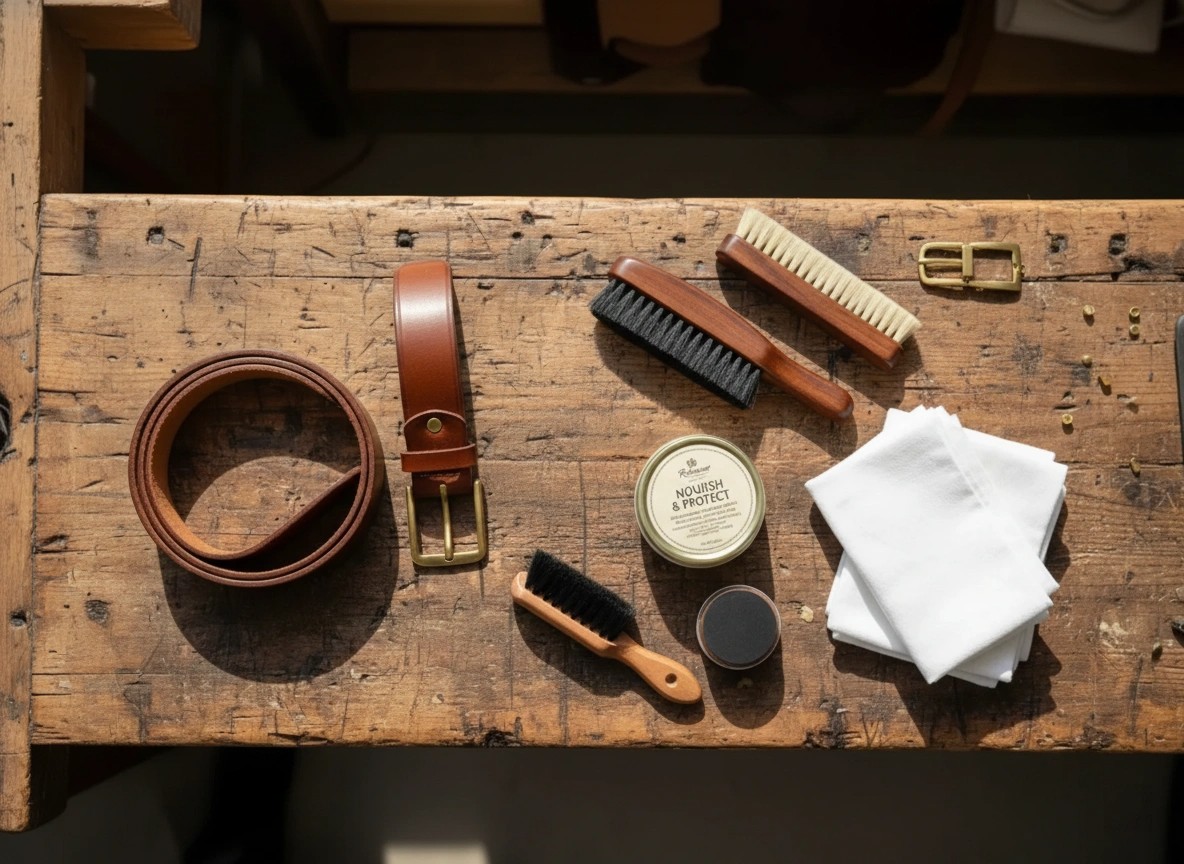
A quality belt represents an investment that should last years, if not decades. Yet many people treat belts as disposable accessories, replacing them frequently due to preventable damage. The difference between a belt that lasts two years and one that lasts twenty often comes down to simple maintenance habits.
This comprehensive guide covers proper care for all belt types—from full-grain leather to embroidered ribbon—ensuring you get maximum life and value from each piece in your collection.
Understanding Belt Construction
Before diving into care specifics, understanding how your belt is made helps you care for it appropriately.
Leather belts consist of leather straps (single or layered), backing material, edge finishing, and hardware. The leather quality varies from full-grain (highest) to bonded leather (lowest). Construction methods include stitching, gluing, or both.
Embroidered belts feature canvas or grosgrain backing with decorative stitching. The embroidery thread quality and backing durability determine longevity.
Ribbon belts use grosgrain or similar woven ribbon, either as a single layer or backed with leather. Hardware includes buckles, D-rings, or hook closures.
Webbing belts employ woven canvas, nylon, or polyester with metal or plastic hardware. Quality varies significantly based on weave density and material grade.
Leather Belt Care: The Foundation
Leather demands the most attention but rewards proper care with decades of use and beautiful aging.
Initial Treatment for New Leather Belts
When you first acquire a quality leather belt, give it the best start:
- Inspect thoroughly: Check for flaws, loose stitching, or finishing issues while you can still return it
- Apply conditioner: Even new leather benefits from conditioning to prevent early drying
- Break it in gradually: Wear for a few hours at a time initially rather than all day, allowing leather to conform naturally
- Avoid water exposure: Keep new leather dry for the first month as it's more vulnerable initially
Regular Leather Conditioning
Leather conditioning prevents cracking, maintains suppleness, and enhances appearance. Think of it as moisturizing—leather is skin and needs similar care.
How to Condition a Leather Belt
- Clean first: Remove surface dirt with a slightly damp cloth, let dry completely
- Apply conditioner: Use a clean, soft cloth to apply leather conditioner in circular motions
- Work it in: Pay special attention to areas that flex most—around the buckle and at your typical wearing hole
- Let absorb: Allow 20-30 minutes for the conditioner to penetrate
- Buff excess: Wipe away any remaining conditioner with a clean cloth
- Let rest: Don't wear for 12-24 hours to allow full absorption
Conditioning frequency:
- Regular wear belts: Every 3-4 months
- Occasional wear belts: Twice yearly
- Dry climates: Monthly or as needed when leather feels dry
- Humid climates: Every 4-6 months
Dealing with Water and Moisture
Water is leather's enemy, causing staining, stiffness, and mildew if not handled properly.
If your leather belt gets wet:
- Remove immediately and blot (don't rub) with an absorbent cloth
- Stuff loosely with paper towels to help maintain shape
- Let air dry naturally away from heat sources—no radiators, hair dryers, or direct sunlight
- Once nearly dry, apply conditioner to prevent stiffness
- Allow to finish drying naturally
Cleaning Leather Belts
Regular cleaning prevents dirt buildup that can degrade leather over time.
Light cleaning (monthly):
- Wipe with slightly damp cloth
- For stubborn dirt, use saddle soap or leather cleaner
- Always follow with conditioning
Deep cleaning (annually or as needed):
- Use leather cleaner specifically formulated for your leather type
- Work in small sections
- Remove all cleaner residue
- Condition immediately after cleaning
- For serious soiling, consider professional leather cleaning
Addressing Leather Problems
Scuffs and scratches: Minor surface marks often disappear with conditioning. For deeper scratches, use color-matched leather cream or polish. Work into the scratch, let dry, and buff.
Color fading: Quality leather dyes penetrate deeply and shouldn't fade significantly. Surface fading can be addressed with leather dye or cream polish matching your belt's color.
Stiffness: Usually indicates drying. Apply conditioner generously and flex the belt gently while conditioning to work it into fibers. Repeat every few days until suppleness returns.
Cracking: Minor surface cracks can sometimes be improved with heavy conditioning, but deep cracks indicate leather breakdown. Prevention through regular conditioning is key—once seriously cracked, replacement is usually necessary.
Caring for Embroidered Belts
Embroidered belts require gentler handling than solid leather but can still provide years of service.
Routine Maintenance
- Brush regularly: Use a soft brush to remove surface dirt and prevent embedding in fabric
- Spot clean promptly: Address stains immediately before they set
- Avoid crushing: Don't fold tightly or stack heavy items on embroidered belts
- Air after wearing: Hang to air out before storing, especially in humid weather
Cleaning Embroidered Belts
Spot cleaning (preferred method):
- Mix mild detergent with cool water
- Dip soft cloth in solution, wring nearly dry
- Gently dab stained area—don't rub vigorously
- Rinse area with clean, damp cloth
- Blot with dry towel
- Air dry flat
Full washing (only when necessary):
- Hand wash in cool water with gentle detergent
- Gently agitate—don't twist or wring
- Rinse thoroughly in cool water
- Roll in towel to remove excess water
- Lay flat to air dry completely
- Iron on low heat if needed, avoiding hardware
Ribbon Belt Maintenance
Ribbon belts are generally low-maintenance but benefit from proper handling.
Regular Care
- Brush after each wear: Remove lint and surface dirt
- Rotate regularly: Don't wear the same ribbon belt daily
- Protect from moisture: While more water-resistant than leather, ribbon still performs better when dry
- Store properly: Hang or roll loosely—avoid tight folding which can crease ribbon
Cleaning Ribbon Belts
Most ribbon belts tolerate hand washing well:
- Hand wash in cool water with mild detergent
- Gently work detergent through ribbon
- Rinse thoroughly until water runs clear
- Press between towels to remove excess water
- Lay flat or hang to dry
- Iron on low heat if wrinkled, using pressing cloth over hardware
Webbing Belt Care
Webbing belts are the most durable and easiest to maintain.
Cleaning Webbing Belts
Canvas webbing: Machine washable in most cases. Use cold water, gentle cycle. Air dry or tumble dry low.
Nylon/synthetic webbing: Hand or machine wash cold. Air dry to prevent heat damage to synthetic fibers.
For all webbing belts:
- Remove any detachable hardware before washing if possible
- Use mesh laundry bag for machine washing to prevent tangling
- Don't use fabric softener—it can coat fibers and reduce durability
- If hardware tarnishes, clean with appropriate metal polish
Proper Storage: Often Overlooked, Always Important
How you store your belts significantly impacts their lifespan.
Best Storage Methods
Hanging: Ideal for all belt types. Use belt hangers, hooks, or tie racks. Allows belts to maintain shape and air circulation prevents moisture buildup.
Rolling: Good for travel or limited space. Roll loosely from buckle end, with buckle on outside. Don't roll tightly—this can create permanent creases.
Laying flat: Acceptable for short-term storage. Stack no more than 2-3 belts to avoid crushing.
Climate Considerations
Dry climates: Leather dries out faster. Store in slightly humid area if possible (not bathroom). Increase conditioning frequency.
Humid climates: Risk of mildew and mold. Ensure good air circulation around stored belts. Use silica gel packets in storage areas. Check regularly for mold signs.
Temperature extremes: Avoid storage in unheated attics (hot summers damage leather) or damp basements (moisture causes mildew). Room temperature storage is ideal.
Hardware Maintenance
Belt hardware deserves attention too.
Buckles and Metal Hardware
Brass/bronze: Develops natural patina over time. If you prefer shine, polish with brass cleaner and soft cloth. For antique finish, embrace the patina.
Stainless steel: Rarely needs more than wiping with damp cloth. For fingerprints, use glass cleaner.
Plated hardware: Most delicate. Avoid abrasive cleaners. Wipe gently with damp cloth. If plating wears through, consider professional re-plating or buckle replacement.
Hardware Problems
Tarnishing: Normal for most metals. Polish if desired, or leave natural.
Rust: Remove with fine steel wool or rust remover. Dry thoroughly and apply clear nail polish for protection.
Loose buckles: Can often be tightened. If rivets are loose, a cobbler can repair professionally.
Seasonal Belt Care
Different seasons demand different attention.
Spring/Summer
- Increase cleaning frequency due to perspiration
- Allow belts to dry completely between wears
- Rotate frequently to prevent salt/sweat damage
- Condition leather more often in dry summer heat
Fall/Winter
- Protect from road salt—extremely damaging to leather
- If exposed to salt, clean immediately with leather cleaner
- Condition before winter to protect against cold dryness
- Store summer ribbon/embroidered belts properly for off-season
Maintenance Schedule Summary
| Task | Leather | Embroidered | Ribbon | Webbing |
|---|---|---|---|---|
| Light cleaning | Monthly | After each wear | After each wear | As needed |
| Deep cleaning | Annually | 2-3 times/year | Seasonally | Monthly |
| Conditioning | Every 3-4 months | N/A | N/A | N/A |
| Inspection | Monthly | Monthly | Monthly | Quarterly |
When Professional Help Makes Sense
Some repairs and maintenance exceed DIY capabilities:
- Broken stitching: A cobbler can re-stitch professionally for $10-20
- Buckle replacement: Cobblers have access to quality replacement hardware
- Leather restoration: Serious water damage, mold, or deep stains often need professional treatment
- Resizing: Adding or removing holes should be done professionally to avoid weakening the belt
For quality belts, professional repair often costs far less than replacement and extends life significantly.
The Investment Perspective
Consider this: A well-made leather belt costs $60-100. With proper care, it lasts 10-20 years. That's $3-10 per year. Leather conditioner costs about $15 and lasts for years of treatments. The time investment? Perhaps 30 minutes twice yearly.
Compare this to buying cheap belts every 1-2 years at $20-30 each. Over 20 years, you'd spend $200-600 on belts that never look as good as quality leather.
Proper belt care isn't just about maintenance—it's about getting genuine value from quality purchases.